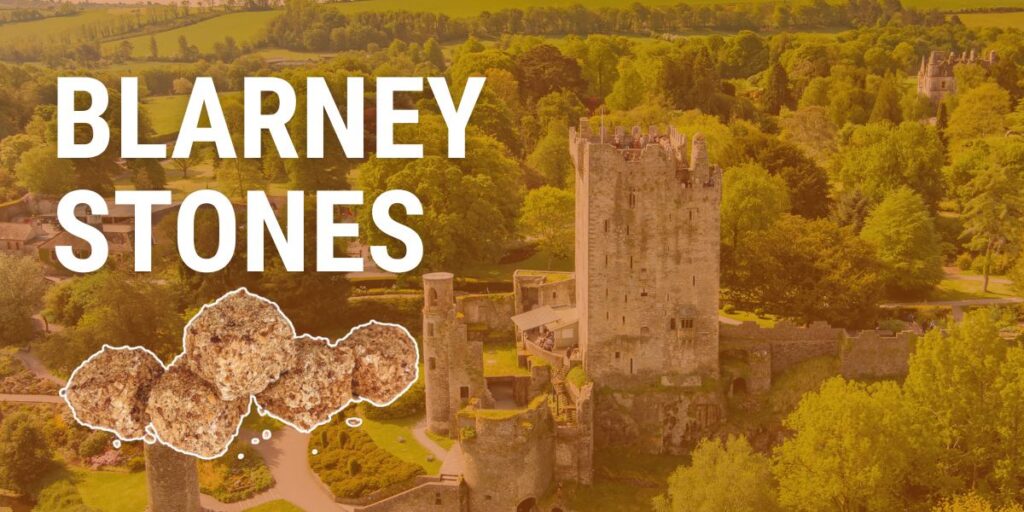
When someone mentions “Blarney Stones,” they might be talking about leaning backward over a castle wall in Ireland—or reaching for a sweet, peanut-covered dessert at a St. Patrick’s Day gathering. Surprisingly, these two very different things share a name but little else in common.
The Real Blarney Stone in Ireland
The original Blarney Stone is built into the battlements of Blarney Castle, located near Cork, Ireland. For centuries, visitors have traveled there to take part in a unique and slightly daring ritual: kissing the stone.
According to legend, kissing the Blarney Stone grants the “gift of the gab”—the ability to speak eloquently, persuade others, and flatter without offending. To kiss it, visitors must lie on their backs and lean backward over a sheer drop while holding onto iron railings. It’s not for the faint of heart!
The stone itself is said to be about 330 million years old and made of local Irish limestone. Stories about its origin vary. Some claim it was brought from Scotland and is connected to the Stone of Scone. Others insist it has magical properties tied to ancient folklore.
The word “blarney,” meaning skillful flattery or charming nonsense, is often traced back to Elizabeth I. Frustrated with the evasive responses of the castle’s lord, she reportedly described his explanations as “all blarney.” The term stuck—and eventually traveled across the Atlantic.
While the Irish landmark is world-famous, in many North American homes, especially in Irish Canadian communities, “Blarney Stones” means something much sweeter.
Blarney Stones: The Dessert
In kitchens across the Maritimes and other Irish Canadian and Irish American communities, Blarney Stones are a beloved homemade treat. They are especially popular around St. Patrick’s Day and sometimes at Christmas.
Are Blarney Stones the Same as Peanut Squares?
Yes. Blarney Stones and peanut squares (or peanut bars) are generally considered the same dessert. The difference is purely in the name, often determined by family tradition. Some families call them Blarney Stones, particularly around St. Patrick’s Day, while others use the more descriptive “peanut squares.”
Occasionally, you might also hear them referred to as “Mocha Squares”—even when they contain no coffee at all.
Functionally, however, they are identical in preparation, ingredients, and taste.
What Are Blarney Stones Made Of?
At their core, Blarney Stones are simple, nostalgic cake squares with a sweet-and-salty twist. Here’s what goes into them:
- Cake Base
- Icing
- Peanuts
The finished squares are placed on wax paper to set until the icing firms up.
Blarney Stones are a classic sweet-and-salty treat. The interior is soft and moist, thanks to the cake. The icing adds creamy sweetness, and the finely chopped peanuts provide a satisfying crunch and savory contrast.
The combination makes them both nostalgic and addictive.
Why They’re Associated with St. Patrick’s Day
The connection is largely in the name. Calling the dessert “Blarney Stones” ties it symbolically to Ireland and Irish heritage. In Irish Canadian communities, particularly in Canada’s Maritime provinces, they became a festive way to celebrate cultural roots.
While you won’t typically find peanut squares in Ireland itself, they’ve become an established part of Irish-North American holiday tables.

Two Blarney Stones, One Name
So, what are Blarney Stones?
- In Ireland, they’re a legendary limestone block at Blarney Castle said to grant eloquence.
- In North America, they’re cubes of pound cake dipped in vanilla icing and rolled in chopped, salted peanuts.
They share a name—but not much else.
One might give you the gift of persuasive speech.
The other will definitely give you crumbs on your plate and a smile on your face.
And on St. Patrick’s Day, many people are perfectly happy choosing the edible version.
Looking to offer your customers some Blarney Stones this St. Patrick’s Day? Take a look at what Valley Makers Studio has to offer or talk with a Valley Sales Rep today!